Do you know what actually happens to water once it leaves your sink, toilet, roof or driveway? For most homeowners, residential drainage only becomes noticeable when something stops working properly. Beneath every UK property is a network of pipes, chambers and outlets that manage wastewater, surface runoff and groundwater. Much of it is hidden from view, which makes it easy to misunderstand what different drains do, what they should look like and what is actually required under UK building standards.
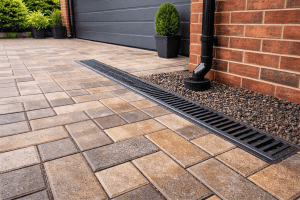
Surface water drains deal with rainwater collected from roofs and hard surfaces. At ground level, they are usually visible as gutters along roof edges, downpipes fixed to walls, grated channel drains set into driveways, or small gullies near patios and paved areas. These feed into underground pipework that carries water away from the building. Surface water drains are extremely suspectable to blockages, because they are open to outside elements that could cause a blockage (such as leaves or gravel), even if said elements make it further down the pipework.
Where surface water discharges to a soakaway, UK guidance requires the soakaway to be located at least 5 metres from any building and at least 2.5 metres from a boundary. This distance is intended to reduce the risk of water affecting foundations or neighbouring land. Surface water should not normally discharge into foul sewers in new developments unless there is no reasonable alternative.
Foul water drains carry wastewater from toilets, sinks, baths, showers and appliances. Inside the property, waste pipes connect to underground drains that are usually accessed via inspection chamber covers set into the ground outside. These covers are typically round or square and flush with gardens, paths or driveways.
UK Building Regulations require foul water to discharge to a public sewer where one is reasonably available. If not, a private system such as a septic tank or package treatment plant may be used. For standard domestic foul drains, the minimum pipe diameter is typically 100mm, and the minimum gradient is usually 1 in 40, meaning the pipe falls 1 unit vertically for every 40 units horizontally. This gradient helps ensure waste flows properly without solids settling in the pipe.
Combined drains carry both surface water and foul water in a single system and are most common in older properties. From the surface, they look the same as separate systems, using standard downpipes, gullies and inspection chambers.
Combined systems are still acceptable in existing buildings, but they are not normally permitted for new developments. There are no specific distance requirements unique to combined drains, but they are subject to the same rules around pipe size, gradients and access points as foul drains.

Larger stormwater drains often run near homes but are not part of the private drainage system. These are typically visible as wide road gullies, large grated inlets or deep manholes in streets and shared areas.
These systems are designed to manage runoff from highways and public land rather than individual properties. They are maintained by local authorities or water companies, and there are no homeowner distance or sizing requirements associated with them, as they fall outside private drainage responsibilities.
Soakaways allow surface water to drain naturally into the ground. They are usually hidden once installed, though they may have a small inspection cover at ground level. Underground, they consist of rubble or modular crates wrapped in a permeable membrane.
As noted earlier, soakaways must be located at least 5 metres from buildings and 2.5 metres from boundaries. There is no fixed depth requirement, as this depends on ground conditions, but they must be installed above the water table and in soil capable of draining water effectively.
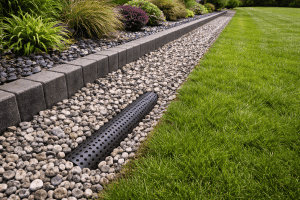
French drains, or land drains, are used to manage groundwater rather than wastewater. Where visible, they often appear as gravel-filled trenches along the edge of a garden or structure. In many cases, they are completely concealed beneath turf or paving.
UK Building Regulations do not set specific distances or dimensions for French drains in domestic gardens. Their design and placement are generally determined by site conditions rather than fixed numerical standards.
Foundation or perimeter drains are installed at or below the base of a building’s foundations and are not visible once construction is complete. They intercept groundwater before it can build up around the structure.
There are no standardised distance measurements for these drains in domestic regulations, as their design depends on the type of building, ground conditions and whether basements or retaining structures are present.
Inspection chambers and manholes provide access to underground drains. On residential properties, these appear as flat covers set into the ground. Smaller chambers usually serve a single property, while larger manholes may serve multiple properties.
UK guidance requires inspection chambers to be installed at changes of direction, changes in gradient, junctions, and at regular intervals on long straight runs. The maximum recommended spacing between access points on a straight run is typically 45 metres. This ensures drains can be inspected and cleared effectively.

Many properties have access covers that look like manholes that lead to drainage (and we in the UK will indeed refer to these as “drains”), but actually serve gas, electricity or telecommunications. These covers may be located within property boundaries or nearby pavements and are often mistaken for drains.
These chambers should not be opened or interfered with. They are maintained by utility providers and do not form part of the property’s drainage system.
If you need advice, inspection or remedial work on your property’s drainage, speaking to a specialist like Drain Division can clarify what you are responsible for and what action, if any, is required.
Contact our team of experts today. Our offices are open 6am to midnight 7 days a week.